Supine Piriformis Stretch
Cross your ankle over the opposite knee, pull the supporting thigh toward your chest, breathe. Hold 45 seconds each side. You should feel a deep, opening sensation in the buttock of the crossed leg, not in the back of the spine. The stretch is glute-deep, not lumbar.
The supine piriformis stretch is one of the most commonly prescribed positions for suspected piriformis syndrome. It places the piriformis (which crosses from the sacrum to the greater trochanter) on maximal length while keeping the lumbar spine in a neutral, supported position. Patients whose sciatic symptoms reproduce with the FAIR test (flexion-adduction-internal rotation) tend to respond best.
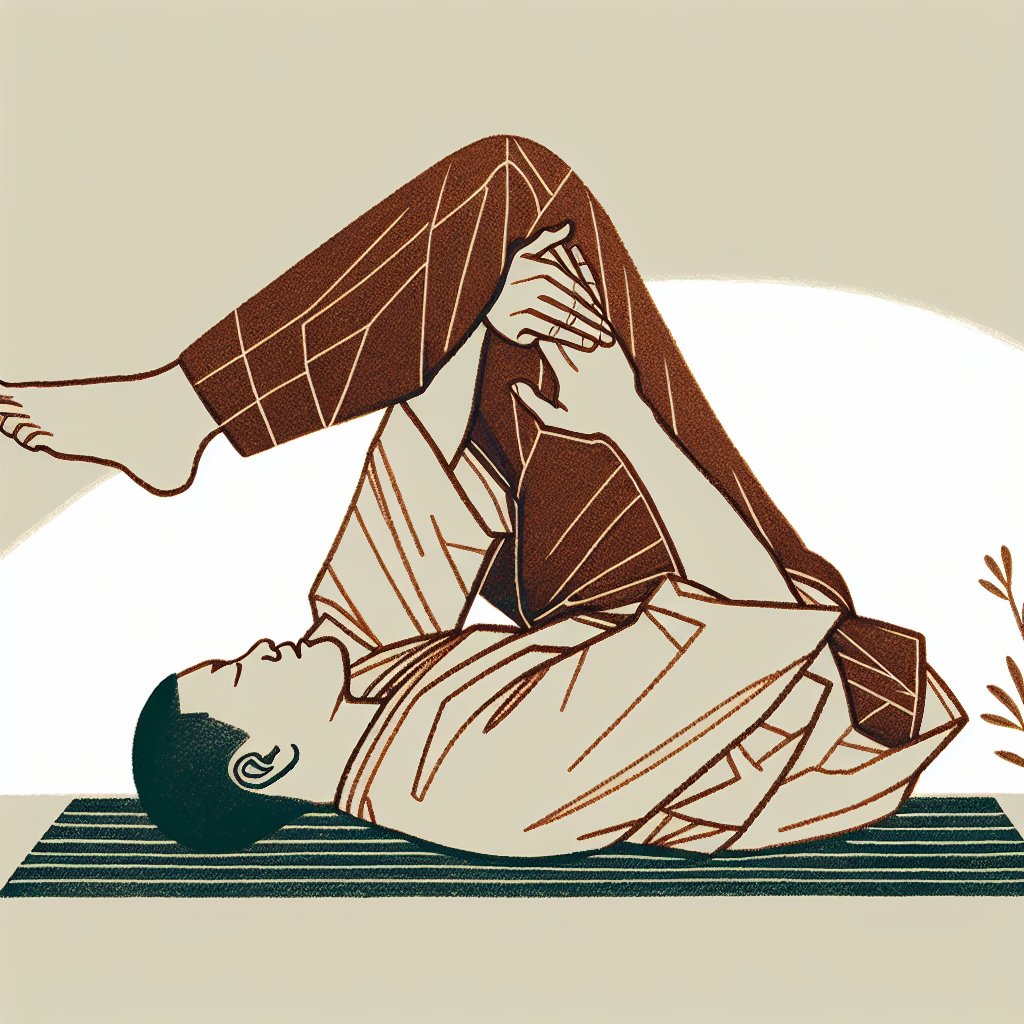
Illustration. Follow the steps for the actual technique.
How to do it
- 1
Lie on your back with both knees bent, feet flat on the floor
Supine start
- 2
Cross your right ankle over your left thigh, just above the knee
Figure-4 the legs
- 3
Reach both hands behind your left thigh, lacing your fingers
Hands behind thigh
- 4
Gently draw the left thigh toward your chest, keeping the right knee falling open
Thigh to chest
- 5
Hold 45 seconds, breathing into the right buttock. Switch sides
Breathe and release
The evidence
The supine piriformis stretch is one of the most commonly prescribed positions for suspected piriformis syndrome. It places the piriformis (which crosses from the sacrum to the greater trochanter) on maximal length while keeping the lumbar spine in a neutral, supported position. Patients whose sciatic symptoms reproduce with the FAIR test (flexion-adduction-internal rotation) tend to respond best.
Citation: Boyajian-O'Neill LA, McClain RL, Coleman MK, Thomas PP (2008). Diagnosis and management of piriformis syndrome: an osteopathic approach. Journal of the American Osteopathic Association
Common questions
How long should I hold the Supine Piriformis Stretch?
Hold the Supine Piriformis Stretch for 45 seconds on each side, breathing slowly. Then switch sides.
What should I feel during the Supine Piriformis Stretch?
A deep, opening sensation in the buttock of the crossed leg, not in the back of the spine. The stretch is glute-deep, not lumbar.
Is the Supine Piriformis Stretch right for disc-bias or piriformis-bias sciatica?
The Supine Piriformis Stretch targets piriformis-bias sciatica: deep buttock pain that worsens with prolonged sitting, without a clear electric pattern running down the leg. It keeps the lumbar spine neutral, so it is not the first choice for disc-bias sciatica, where symptoms instead centralise with back extension.
When should I stop the Supine Piriformis Stretch?
If pain peripheralises (moves further down the leg) during this stretch, stop immediately. That is nerve root irritation, not piriformis stretch. See a physiotherapist before resuming.