Child's Pose (Modified for Sciatica)
Knees wide, hips back to heels, forehead down. Breathe slowly into the low back. Hold 60 seconds. You should feel a passive opening across the low back and into the hips. The knees-wide variant takes pressure off the abdomen and creates more space for the lumbar spine to round comfortably. Should feel calming, not pulling.
Child's pose is generally well tolerated in sciatica and a frequent component of the acute-phase routine, particularly the knees-wide variant which avoids compressing the abdomen and allows the lumbar spine to round more freely. It decompresses the lumbar facet joints and gently lengthens the paraspinals, which often spasm protectively around an irritated nerve root. The caveat: if pain peripheralises with lumbar flexion (the classic disc-bias presentation), child's pose may not be appropriate; in those cases the centralisation test directs you toward prone extension positions instead.
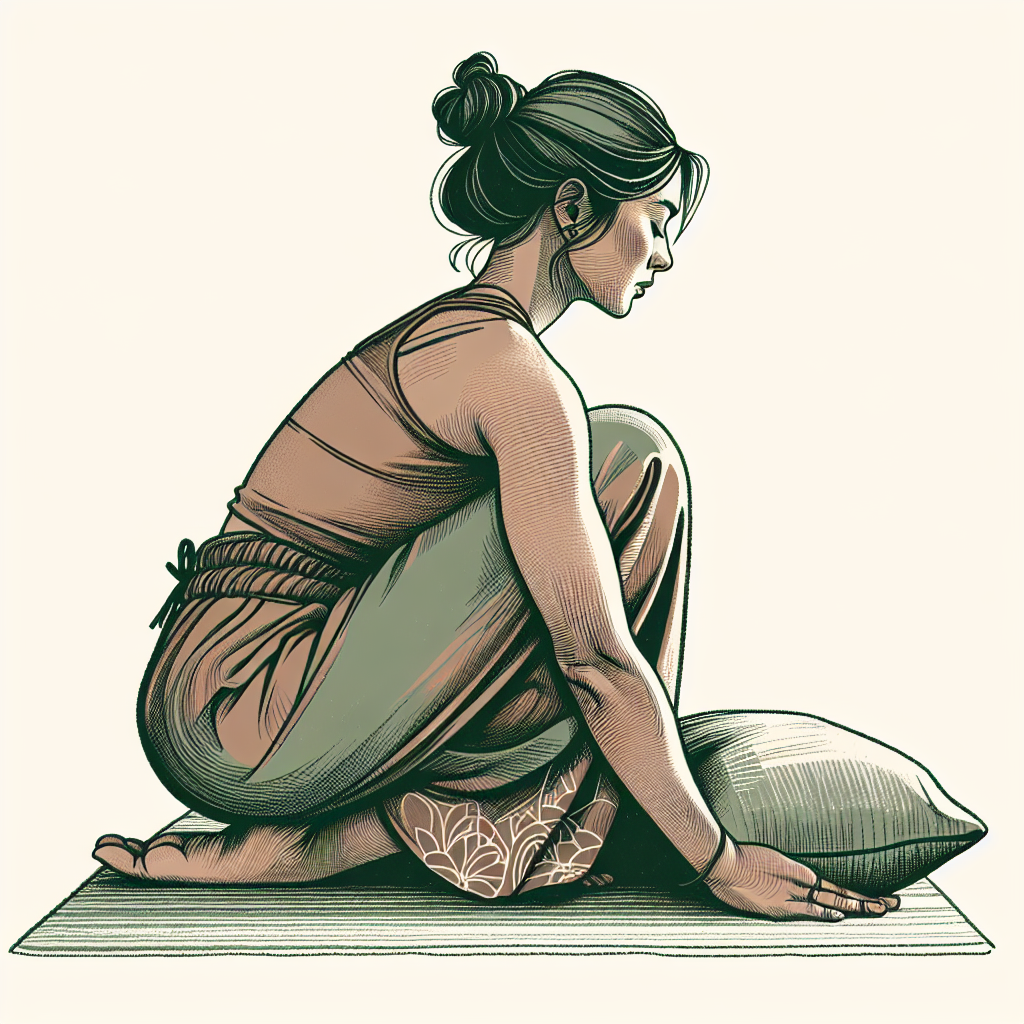
Illustration. Follow the steps for the actual technique.
How to do it
- 1
Start on hands and knees, knees wider than hip-width (slightly wider than usual)
Knees wide
- 2
Sit your hips back toward your heels
Hips to heels
- 3
Walk your hands forward, lower your forehead to the floor or a cushion
Arms long
- 4
Allow the low back to round gently. Breathe into the back of the ribs
Round and release
- 5
Hold 60 seconds. If one buttock or leg feels pulled, gently shift hips an inch the opposite way to find ease
Find the comfortable position
The evidence
Child's pose is generally well tolerated in sciatica and a frequent component of the acute-phase routine, particularly the knees-wide variant which avoids compressing the abdomen and allows the lumbar spine to round more freely. It decompresses the lumbar facet joints and gently lengthens the paraspinals, which often spasm protectively around an irritated nerve root. The caveat: if pain peripheralises with lumbar flexion (the classic disc-bias presentation), child's pose may not be appropriate; in those cases the centralisation test directs you toward prone extension positions instead.
Citation: Wieland LS, Skoetz N, Pilkington K, Vempati R, D'Adamo CR, Berman BM (2017). Yoga treatment for chronic non-specific low back pain. Cochrane Database of Systematic Reviews
Common questions
How long should I hold the Child's Pose (Modified for Sciatica)?
Hold the Child's Pose (Modified for Sciatica) for 60 seconds, breathing slowly.
What should I feel during the Child's Pose (Modified for Sciatica)?
A passive opening across the low back and into the hips. The knees-wide variant takes pressure off the abdomen and creates more space for the lumbar spine to round comfortably. Should feel calming, not pulling.
Is the Child's Pose (Modified for Sciatica) right for disc-bias or piriformis-bias sciatica?
The Child's Pose (Modified for Sciatica) suits either sciatica pattern. It mobilises the nerve or gently decompresses the spine rather than forcing the joint hard in one direction, so it is appropriate for both disc-bias and piriformis-bias presentations.
When should I stop the Child's Pose (Modified for Sciatica)?
If the forward fold pushes pain DOWN the leg further, stop and try the prone cobra instead. This is the centralisation principle in action: peripheralising = bad, centralising = good.